WhatsApp's Free 24-Hour Window Ends on 1 October: What Changes for Your Store
Right now, every reply your team sends inside a WhatsApp conversation is free. From 1 October 2026, Meta starts charging for those replies. Here is the change in plain language, and what to fix in your WhatsApp setup before it lands.
Aug 18, 2026•6 min
Contents
On 1 October 2026, WhatsApp starts charging for the replies your team sends inside a customer conversation. Today those replies are free, and most retail WhatsApp operations quietly run on that fact.
Meta published the change in its developer documentation, written for engineers. Here is the same thing in plain language, written for the person who runs the store rather than the one who wired up the API.
Templates and normal messages: the difference
Everything your business sends on WhatsApp is one of two things.
A template message is written in advance and approved by Meta before you can use it — 'Your order has been shipped', 'Your Diwali offer is live'. You need one whenever you want to start a conversation, or reach a customer who hasn't written to you recently. Templates have always cost money, priced by category: marketing, utility, or authentication.
A normal message is anything your team types out in the moment. 'Yes ma'am, we have it in 22 carat.' 'Store closes at 9.' 'Sending photos now.' Meta calls these service messages. You can only send them when the customer has messaged you in the last 24 hours.
What is free today
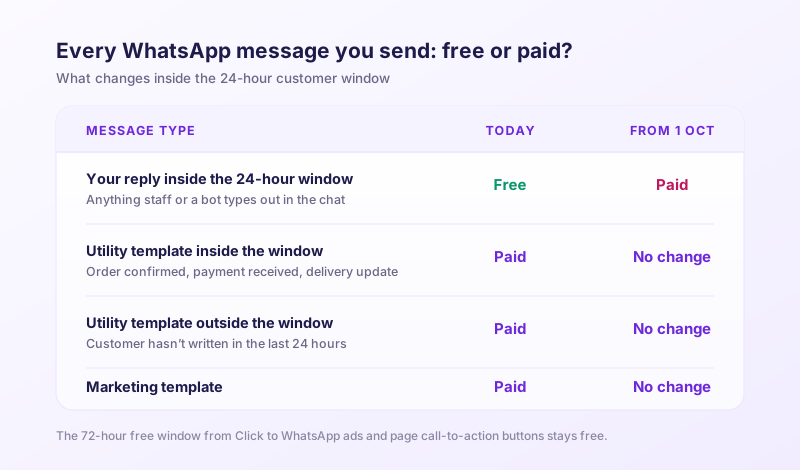
When a customer messages your business, a 24-hour window opens. Inside that window, every normal message you send back is free. The window resets each time the customer writes again, so an active conversation can run for days — twenty messages, product photos, price quotes, the lot — at zero cost.
Templates are billed either way — marketing, utility or authentication, inside an open window or after it has closed. What has been free is everything your team types out itself.
What changes on 1 October
The free part ends. From that date, every normal reply you send inside the 24-hour window is charged.
Meta prices these replies at the same rate your market already pays for a utility message. India sits among the cheapest markets in the world for this, so any single reply costs very little. One detail worth noting: Meta has said there are no volume discounts on replies, so the rate stays flat whether you send a thousand a month or a million. Final figures are confirmed by 1 September 2026, and the rate card your provider bills you against is where to check yours.
The window itself works exactly as before. You still can't message a customer after 24 hours without a template. It simply stops being free to reply within it.
How to work out your own number
Take a jewellery chain with six showrooms handling 3,000 WhatsApp conversations a month, with six replies from the store in an average conversation. That is 18,000 outbound replies — every one free today, every one chargeable from 1 October.
The sum for your own store is short enough to do on a phone: last month's outbound message count × your utility rate, plus GST. That rate sits on the WhatsApp rate card your provider bills you against, and it differs by country.
For most Indian retailers the answer lands modest — small enough to get ignored until an invoice arrives carrying a line that read zero last quarter. The stores that get a real shock are the ones sending far more messages per conversation than they realise.
Where it really hurts: chatty bot flows
The per-message rate is low. The message count is where the damage is, and most retail WhatsApp setups are far more talkative than they need to be.
A typical automated flow greets the customer, asks for a language, offers a menu, confirms the choice, and then finally answers the question. Five messages where two would do. Free today. From October it costs two and a half times what a tighter flow costs, on every single conversation, forever.
The same goes for humans. 'Hi', 'Please hold', 'Checking', 'Thank you' — four separate bubbles that could have been one reply with the actual answer in it. Most teams can cut a third of their outbound volume without a customer noticing anything except faster service.
What is not changing
• Marketing template prices stay exactly as they are. Your festive broadcast costs what it cost last month. • Utility and authentication templates are unchanged, inside an open window or outside it, volume tiers included. • The 72-hour free entry point window — conversations that begin from a Click to WhatsApp ad or a Facebook page call-to-action button — remains free. • The 24-hour window rules work the same way, resetting with every customer message.
Five things to do before 1 October
1. Count what you send. Pull last month's outbound message count from your WhatsApp inbox and multiply it by your utility rate, then add GST. That is your new baseline. Ten minutes of work removes all the guesswork from the rest of this list.
2. Cut the filler. Every 'Hi', 'Please hold' and 'Thank you' now has a price. Merge them into fewer, complete replies that carry real information.
3. Shorten your bot flows. Count the messages your automation sends before the customer gets a useful answer. If it is more than two, redesign it. This is the single biggest saving available to most retailers.
4. Fix your top five repeat questions. Store timings, today's gold rate, order status, EMI options, return policy. Each should be answerable in one message that actually resolves it, rather than four messages of clarification. Every round trip you avoid is money now.
5. Watch for the 1 September announcement. Meta has committed to publishing final rates for replies by then. Confirm the figure for your market with your provider before you sign off on a budget, and remember Indian invoices carry GST on top of Meta's list rate.
None of this is a reason to send fewer answers or leave customers waiting. It is a reason to make each message count — which is what a good WhatsApp operation was doing anyway, back when the messages happened to be free.
Does this mean WhatsApp customer support is no longer free?
From 1 October 2026, yes. Until then, replies you send inside the 24-hour customer window cost nothing. After that date each reply is charged at the same rate your market already pays for a utility message. The window still works the same way, it just stops being free to reply inside it.
What is the difference between a template message and a normal message?
A template is written in advance and approved by Meta, and you need one to start a conversation or to reach a customer who hasn't messaged you in the last 24 hours. A normal message is anything your team types out live in an open chat. Templates have always been charged. Normal messages have been free until now.
Will my marketing campaign costs go up?
No. Marketing template pricing is untouched by this update. What changes is the conversation that follows a campaign: when customers reply to your broadcast and your team answers, those answers become chargeable from 1 October. Campaigns that generate a lot of chat now carry a small cost on the back end.
Does this change anything about my order and delivery updates?
No. Those go out as utility templates, and utility templates are charged today whether the customer is actively chatting with you or not. Their price is untouched by this update. What changes is the free-text reply your staff or bot sends afterwards, in the conversation the update opens up.
What about conversations that start from a Click to WhatsApp ad?
The 72-hour free entry point window is unchanged. Conversations opened from a Click to WhatsApp ad or a Facebook page call-to-action button stay free for message delivery, exactly as they are today.
Do volume discounts apply to these replies?
No. Meta has stated it does not offer volume tiers for service messages, so the rate stays flat no matter how many you send. Utility and authentication templates keep their existing volume tiers.
How much will this add to my monthly bill?
Take last month's outbound message count, multiply it by your utility rate and add GST. For most Indian retailers the total comes out modest, because India's per-message rates are among the lowest anywhere. The stores that get a surprise are the ones whose bots send four or five messages before the customer gets a useful answer.
What rate will my replies actually be charged at?
Meta has said replies will be priced to match the utility and authentication rates already set for each market, so your country's existing utility rate is the number to plan against. Final figures are confirmed by 1 September 2026 — check the published rate card, or ask your WhatsApp provider directly, before locking a budget.
WHATSAPP PRICINGWHATSAPP BUSINESS APIRETAIL CRMWHATSAPP MARKETINGCUSTOMER SERVICE
Get your WhatsApp message count down before 1 October
Get a free personalised demo of Zithara.AI
Zithara.AI
Learn more about retail CRM, loyalty programs, WhatsApp marketing, and AI agents for retail on the Zithara blog.
Written by Ravi Bhushan Ojha
VP – Product Engineering, Zithara.AI
Ravi leads product and engineering at Zithara.AI, building AI-powered CRM, loyalty programs, and WhatsApp automation for retail and consumer brands across India and globally. He works closely with jewelry chains, fashion retailers, and electronics brands to help them use data and AI to grow customer lifetime value — without needing a large tech team to make it happen.
Don't just read the playbook. Become it.
Someone else should be learning from your store next.
You've seen how 300+ retailers did it. Be the next example — the brand others screenshot. A 20-minute demo is how that story starts.
Book a Demo Now
Fill out the form below and we'll get back to you soon.