Jewellery Retail Is Changing. The Customer Is Leading. AI Is Accelerating It.
Four shifts reshaping jewellery retail, and why understanding the customer will define the next era of growth for jewellery brands.
Contents
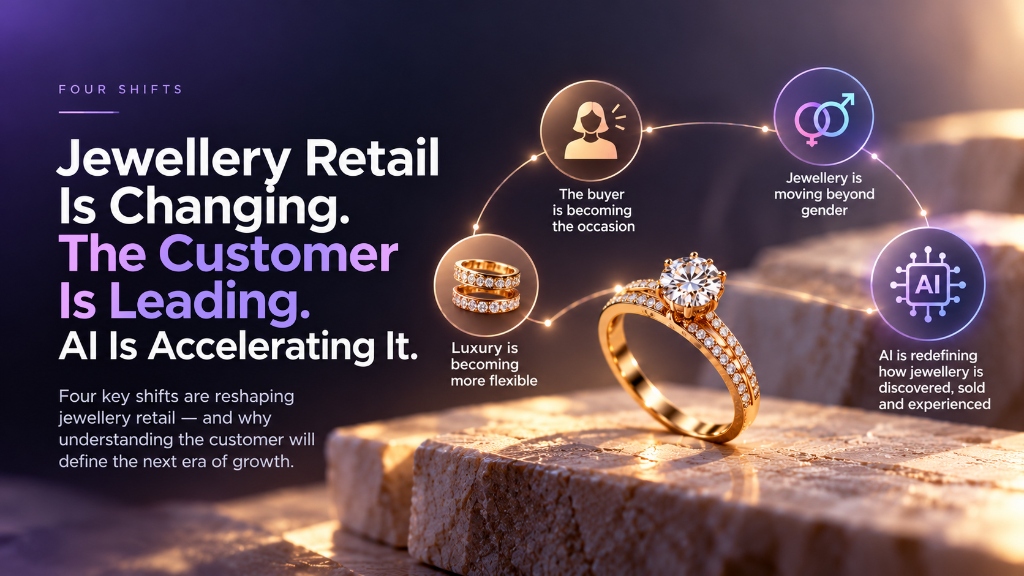
Four shifts reshaping jewellery retail — and why understanding the customer will define the next era of growth.
For decades, jewellery retail has been built around moments.
Weddings. Engagements. Anniversaries. Festivals. Family celebrations.
These occasions continue to matter. But something more fundamental is changing in how customers discover, choose and purchase jewellery.
Customers are increasingly buying for themselves. Personal expression is influencing product choices. Jewellery collections are becoming more flexible. And AI is creating new opportunities for retailers to understand and engage customers throughout their buying journeys.
For jewellery retailers, this is not simply a change in product trends.
It is a change in the relationship between the customer and the brand.
Here are four shifts that deserve attention.
1. The Buyer Is Becoming the Occasion
Traditionally, jewellery marketing has focused on occasions.
A wedding collection for the bride. A diamond pendant for an anniversary. A special gift for a birthday.
Today, self-purchasing is becoming an increasingly important part of the jewellery market.
Women are buying jewellery to celebrate promotions, achievements, personal milestones and individual preferences — sometimes without any particular occasion at all.
This creates a new opportunity for jewellery retailers.
Brands no longer need to wait for an occasion. They can help create one.
But doing this effectively requires a better understanding of individual customers.
What collections have they explored? What did they purchase previously? What styles interest them? When did they last engage with the brand?
These signals can help retailers move beyond generic festive campaigns towards more relevant, personalised engagement.
The opportunity is not to send more messages. It is to make each interaction more meaningful.
2. Jewellery Is Moving Beyond Gender
Jewellery has traditionally been organised and marketed through gender-based categories.
That distinction is becoming less rigid.
Diamonds, pearls, earrings, chains and other designs are increasingly being embraced as forms of individual expression.
For retailers, the opportunity is not simply to introduce a unisex collection.
It is to reconsider how they understand customer preferences.
Instead of asking: "Who is this jewellery designed for?"
The more relevant question may be: "What does this jewellery allow someone to express?"
This shift has implications beyond product design.
Customer segmentation and marketing also need to evolve.
Purchase history, browsing behaviour, design preferences and expressed interests can provide more useful signals than demographic categories alone.
Retailers that understand individual preferences can build more relevant customer experiences.
3. Luxury Is Becoming More Flexible
For many customers, luxury jewellery has traditionally meant investing in a significant piece intended to be worn for years.
That model remains important, particularly in markets where jewellery carries cultural, financial and emotional significance.
But another buying behaviour is emerging alongside it.
Customers are experimenting with layering necklaces, stacking rings, combining collections and building jewellery wardrobes.
Instead of a single major purchase, customers may make multiple purchases over time.
Jewellery is becoming less static — and more like a wardrobe.
This changes how retailers should think about product strategy and customer relationships.
Collections can encourage layering, stacking, combining and repeat purchases.
But the larger opportunity lies in what happens after the first sale.
A customer who purchases a ring today may be interested in a complementary piece months later. Someone exploring a particular design may be interested in a new collection with similar characteristics.
Understanding previous purchases and preferences makes these interactions more relevant.
The next purchase starts with understanding the last one.
For retailers, this creates an opportunity to shift from transaction-focused marketing towards customer lifecycle engagement.
4. AI Is Redefining How Jewellery Is Discovered, Sold and Experienced
The first three shifts have something in common.
They make the customer journey more individual, less predictable through traditional demographic categories and increasingly dependent on understanding personal preferences.
This is where AI becomes particularly relevant.
Jewellery retailers already interact with customers across multiple touchpoints.
• A customer discovers a collection through Instagram.
• They enquire through WhatsApp.
• They explore the website.
• They visit a showroom, compare designs and leave without purchasing.
• Weeks later, they may return or respond to another campaign.
• They enquire through WhatsApp.
• They explore the website.
• They visit a showroom, compare designs and leave without purchasing.
• Weeks later, they may return or respond to another campaign.
Each interaction reveals something about the customer's interests and buying intent.
Yet in many retail businesses, this information remains scattered across disconnected systems.
The challenge is not a lack of customer interactions.
It is the inability to connect those interactions into meaningful customer intelligence and action.
AI can help retailers bridge that gap.
Understand buying intent
Not every enquiry represents the same level of purchase readiness.
AI can help interpret customer conversations, identify intent signals and prioritise opportunities for sales teams.
Personalise customer engagement
Customer preferences, purchase history and engagement behaviour can help retailers create more relevant customer segments and communications.
Connect digital discovery with showroom visits
A customer journey rarely happens through one channel.
Connecting enquiries from advertisements, websites, social platforms and WhatsApp with in-store interactions gives retailers a more complete view of customer interest.
Anticipate the next opportunity
Purchase patterns, customer behaviour and engagement signals can help identify when a customer may be ready for another interaction.
Build relationships beyond the first purchase
Automated customer journeys can support follow-ups, collection launches, personalised campaigns and retention marketing.
The objective is not to replace the human element of jewellery retail.
It is to give retailers better intelligence so they can create more relevant customer experiences.
From Customer Data to Customer Intelligence
For years, retailers have invested in systems to store customer information.
But storing customer data and understanding customer behaviour are two different things.
A traditional customer database may tell a retailer what someone purchased.
An intelligent customer engagement platform can help connect that purchase with enquiries, preferences, conversations, showroom visits and subsequent engagement.
This is the difference between maintaining customer records and using customer intelligence to drive action.
For jewellery retailers, the commercial opportunity spans the entire customer lifecycle:
• Capturing and responding to enquiries.
• Converting interest into showroom visits and purchases.
• Understanding customer preferences and purchase patterns.
• Building personalised engagement journeys.
• Encouraging repeat purchases and long-term loyalty.
• Converting interest into showroom visits and purchases.
• Understanding customer preferences and purchase patterns.
• Building personalised engagement journeys.
• Encouraging repeat purchases and long-term loyalty.
Where Zithara.AI Fits In
Zithara.AI is an AI-native customer intelligence and revenue growth platform designed to help retailers connect customer interactions across online and offline channels.
From Instagram, Facebook, Google and WhatsApp enquiries to showroom visits, purchases and follow-ups, Zithara helps retailers bring customer information into a connected view.
Its AI-powered lead management, intent scoring, Customer 360, segmentation, journey automation and omnichannel engagement capabilities help retail teams move from customer information to revenue-generating action.
The goal is straightforward:
Capture every opportunity. Understand every customer. Make every interaction count.
The Future of Jewellery Retail Is Personal
Jewellery will always be emotional.
Customers will continue to buy jewellery to celebrate, express themselves, create memories and mark important moments.
Technology does not change that fundamental relationship.
It can make the experience more relevant, connected and intelligent.
The jewellery brands that succeed in the years ahead will not simply be those with the largest collections or the biggest marketing budgets.
They will be the brands that understand their customers better — and act on that understanding consistently.
Jewellery will always be emotional. The experience can now be intelligent.
Discover how Zithara.AI helps jewellery retailers turn customer intelligence into revenue at www.zithara.ai.
JEWELLERY RETAILCUSTOMER INTELLIGENCEAI FOR RETAILPERSONALISATIONRETAIL CRM
Turn customer intelligence into revenue
Get a free personalised demo of Zithara.AI
Zithara.AI
Learn more about retail CRM, loyalty programs, WhatsApp marketing, and AI agents for retail on the Zithara blog.
Written by Ravi Bhushan Ojha
VP – Product Engineering, Zithara.AI
Ravi leads product and engineering at Zithara.AI, building AI-powered CRM, loyalty programs, and WhatsApp automation for retail and consumer brands across India and globally. He works closely with jewelry chains, fashion retailers, and electronics brands to help them use data and AI to grow customer lifetime value — without needing a large tech team to make it happen.